Wednesday, May 7, 2014

Towering Above...


"Every age, every culture, every custom and
tradition has its own character, its own weaknesses
and strengths, its own beauties and ugliness..."
~Hermann Hesse

 When last I wrote, I mentioned that Mike and I had walked through the Boquería our Saturday afternoon in Barcelona. What I didn't mention is that prior to going there, we watched the castellars. If you've looked at the photos, you probably have guesses that castellars are people who form castells (castle).  The plaza was wall-to-wall people who were there to watch the teams build the towers, and we pushed as close as we could to get near them. 

The castellars have roots in 18th-century Catalunya, and while it has spread to other areas, it remains most popular in that province. The teams always wear white pants and black sashes, but each team wears a different shirt color. The sashes are the most important part of the uniform because they not only support the castellars' backs but also serve as a hand or foothold for those climbing higher. Some castellars wear bandanas (See photo below.), and only the child who tops the castell wears a helmet.  (Yes, a child climbs to the top.  See the photo above, and you can see the girl climbing into place.)


The castellars build the tower in two movements. The first is formation of the base (pinya, which means bulk). There can be as many as a couple hundred people on this level because it is the one that gives strength and stability to the tower. Ironically, the level doesn't usually get much attention, but it is so important because besides giving the stability, it also serves as a cushion should the upper levels fall.

(Note: In none of these photos do you see the base layer. If you look at the second layer above, you can see hands of the pinya supporting them.)

The way the castellars build the tower depends on the number of layers, how many people per layer, and the rising.  Some of the forms require the succeeding layers to climb up the backs of the lower layers. (See photos below.)  Another way to build the tower is to pull the castellars up through the middle of each layer, a method that requires strength to hold and to yank up.


The top layer is usually a child.  Once the child reaches the top, he/she raises four fingers and climbs down the side opposite the side he/she climbed up.  The other layers shimmy down in order.  For the build to be successful, every movement must go smoothly.


There are, of course, times when things go wrong, and the towers do collapse before the last layers get up.  As I mentioned before, the pinya is important in these cases as they do provide a buffer for the falling people.  As a matter of fact, the team pictured here did fall in on themselves during a climb. When recovered, they successfully built a seven-level castell.


The tallest castell built the day we were there was eight layers high.  From what I remember, the record is 10 levels.  In addition to the castells with multiple people per layer, there are castells that are one person per level, two per level, three per level, etc.

If you are interested in seeing a great video of a castell, click here.  If you'd like to see a castell fail, click here.


Next time:  Fire!

Sunday, May 4, 2014

My, What a Big Head You Have!

Capgrosso (Note the carrier's eyes)

“Only mystery makes us live. Only mystery.” 
Federico García Lorca

I'm telling this story out of order, but I guess you won't mind too much since, until I mentioned it, you probably had no idea it was out of order.  ;-)

Mariner gegants
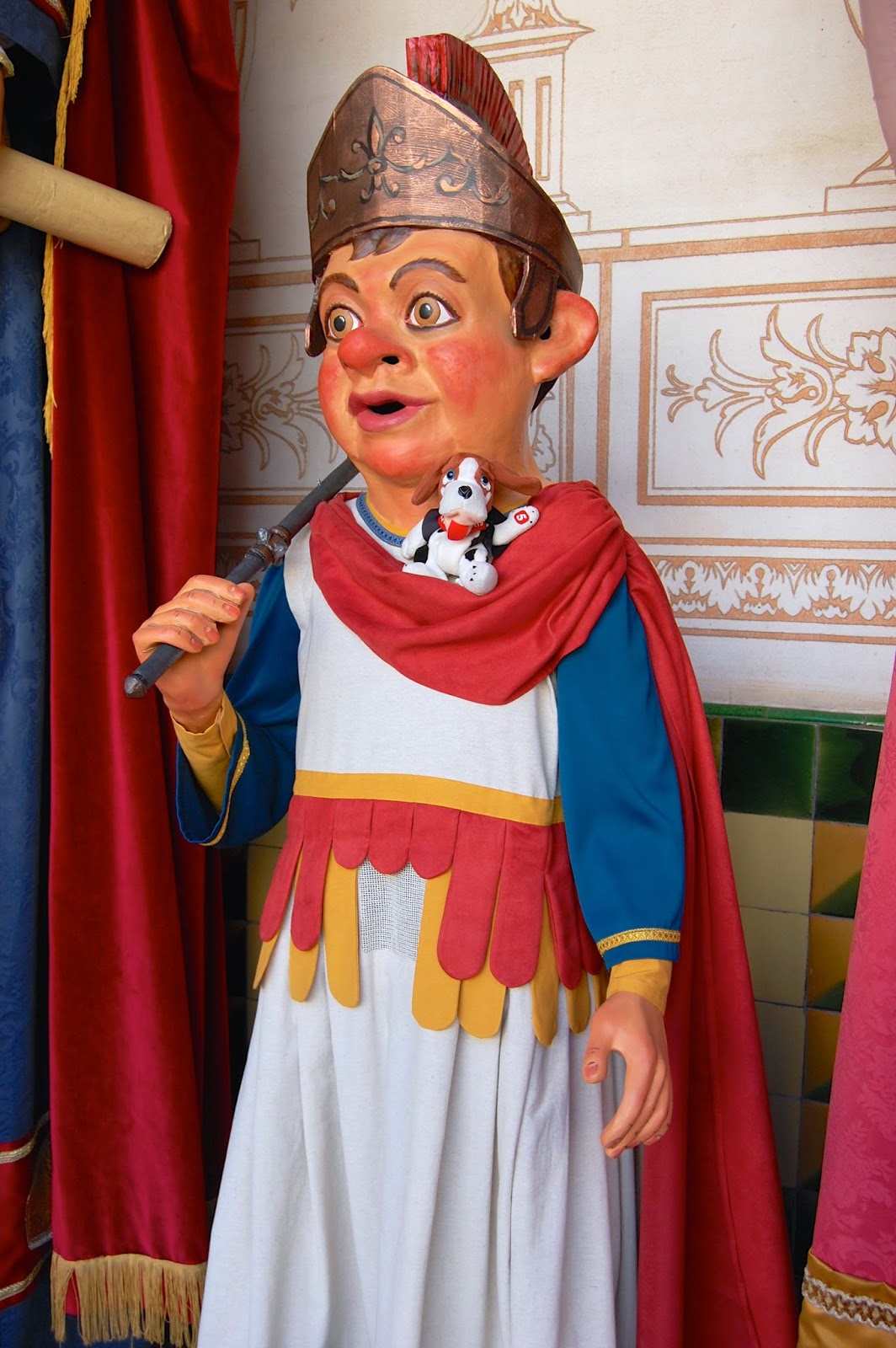
At any rate, on the Saturday afternoon that we were in Barcelona, we went to the Boquería (the most wonderful market) for a bit before heading back to our hotel to rest.  Mike walked up a few steps and looked through an archway and found a large courtyard.  On the sidewalk surrounding the courtyard were gigantic figures.  Some were at least twice Mike's size (photo below), while others were more his size with over-sized heads (above).  We thought we'd stumbled on some type of museum of giants as I'd never read anything about giants.

No one was around, so we just walked around and took photos. (Side note: I used to take NewsHound, mascot of the TV staion where Mike worked at the time, with us on trips. He was quite taken with the smaller giants in Barcelona.) 
 

NewsHound and a caprosso

 Later that evening, we had dinner somewhere in the Barri Gòtic and headed back to the hotel.  As we got closer to Las Ramblas, we heard drums, music, and excitement. When we got to Ramblas, we found ourselves in the middle of a parade of the giants and the big-headed people. Being as the giants were so huge, we were quite amazed at how deftly the men carrying them danced down the street. It was quite a spectacle.

A pair of gegants (Note the carrier's face)

  "¡Vimos los gigantes! (We saw the giants!)" I told Alejandro, the night clerk as we walked past him to the elevators once back at our hotel.

"Gegants," he replied.

"¿Qué? (What?)" I asked.

"EEt ees no gigantes," he explained. "Een Català, ees gegants." Alejandro was helping me navigate the bridge between Spanish and Catalan. Considering he was Brazilian and that Portuguese was his first language, he was sometimes confused himself.  I wasn't going to attempt to tell him the big heads were in the parade, too.

Wild Boar Capgrosso
Interestingly, the origin of the gegants goes back to the Middle Ages.  In an attempt to teach the illiterate masses about God, the Catholic Church used them in theatrical presentations of the Bible and other church teachings.  The church also used capgrossos (big heads) in similar ways.  The original gegants represented the apostles, good (lions, eagles) and evil (devils, dragons).

The first mention of gegants in Barcelona is in a document written in the 15th century.  Today, there are 4,000 gegants in Catalunya and 7,000 more in Spain.  There are more than 85 other countries that have giants in their cultures.

In Catalunya, the gegants usually appear in pairs — one male and one female.  If you look at the photo of Mike with the two gegants, you'll see that the gegants are a fisherman and his wife who is holding a fish.  The gegants are quite expensive, costing upwards of €6000 ($7800) for one.

The gegants and capgrossos are an important part of the culture of Catalunya, and each village, town, even neighborhood has its own pair.  They make their appearance during major festivals, holidays, and celebrations. 

Next time: Towering Over Us...

Saturday, May 3, 2014

Barcelona


 "Everyone's got unfinished
business with Barcelona."
 Frank Lampard

The essay I wrote when applying for the MFA program at Murray State was about my first trip to Barcelona.  As you may or may not know, I majored in Spanish and English in college and lived in Mexico for a semester.  Spain, for some reason, was never on my radar. 

For our 30th anniversary in 2007, Mike suggested we do a repositioning cruise from Amsterdam to Barcelona.  Six months after that first suggestion, we were standing on Plaça Catalunya (main square in Barcelona) looking for our hotel since we'd decided to spend three extra days there.

As luck would have it, we were there during Festes de la Mercé, one of the largest festivals in both Barcelona and Catalunya (the province), and the streets were crowded with  revelers.  Crowds are not exactly my thing (as you might have guessed if you've read any of my blog), and I was quite anxious yanking luggage down a main street in the midst of a bunch of screaming people.  Luckily, we'd walked only a few blocks before we saw the hotel.

 La Mercé, as locals call the festival, is the grandest annual celebration in the city and province and honors the Virgen of Mercy, patron saint of Barcelona. The story is that the city suffered from a plague of locusts in 1687, and the residents prayed to the Virgen to deliver them from the pests.  She drove them out, and the city honored her with the festival.


While the actual feast day is 24 September, the festivities span a number of days. In addition to parades, concerts, dances, fireworks, food, and wine, La Mercé also includes the castellars, the gegants, capgrossos, and the correfoc.  The castellars are human towers (center photo), a Catalan tradition.  The gegants and capgrossos are paper maché  giants (photo below) and big heads.   The correfoc are "fire runners."  (I'll tell you more about these in the next few days.)

One of the reasons I was so happy to be finally going to Barcelona was because I speak Spanish.  Castilian Spanish (castellaño) differs from the Spanish I learn/speak in much the same way as British English differs from American English.  What I didn't stop to think until long after I arranged the trip was the fact that the residents of Barcelona do not speak even castellaño.  They speak Catalan.  If you look at the foreign words in this blog, you'll notice that the words are not Spanish.  Oops.

When Franco was dictator of Spain, he forbid all of the provinces from speaking their languages and required everyone to speak castellaño.  Anyone who broke that law and got caught was thrown in jail.  Castellaño is still the lispy national language of Spain, but since Franco's death in the 70s, Spaniards have been permitted to once again speak their own languages.  Catalunya actually requires all business and government documents to be in both castellaño and catalano.

Confused? Just wait.


 Speaking of language (What a segue!)....  If you ever watched Seinfeld, you might remember the Soup Nazi episode where Newman sniffs his soup and skip-hops down the street while sing-songing, "Jam-ba-LY-a."    That's how I refer to this wonderful city.  All together now:   Bar-the-LOW-na!

Tomorrow:  Gegants & capgrossos

Friday, May 2, 2014

Full of Bologna

Bologna is the best city in Italy for food and 
has the least number of tourists. 
With its medieval beauty, it has it all.
~ Mario Batali

I've made a mistake every time we've gone to Italy. The first few times, I avoided Bologna because I thought it had not much to offer.  Last year, we spent five days there only because the flight home from Bologna was more affordable and more convenient, and those five days proved to me that I was very wrong about that charming city.

Everyone I know (and many I don't) who has gone there raves about the food in Bologna.  I have to agree that Bolognese food is good, but I prefer Abruzzese food.  There are some subtle differences in sauces and pastas and some big differences in the offerings.  I guess what I'm saying is that the food was not my reason for liking Bologna.

What it comes down to is that Bologna does, indeed, have a simple beauty that we didn't find in other large cities. Yes, Rome, Florence, Venice, Turin, and Milan are beautiful cities. They remind me of a rich great-aunt whom one sees every five years. She dresses in white lace and black velvet, drips in gold, exudes lilac or old rose from every pore, and proffers her cheek for a peck so we don't smudge her lipstick.

Bologna, though, is more the loving grandmother who wears a plain cotton dress and apron, smells of Ivory soap, envelopes us in her arms each time she sees us, and smears lipstick on our cheeks when she kisses us. She is down-to-earth. Warm. Inviting.

I'm thinking about spending time in Bologna in late summer or fall. I was comfortable there, and I know the guy who owns the apartment where we stayed last year.   Because Bologna has a good central location, I can easily take the train to Florence, Venice, Milan, and many other cities for a day.  I know where the markets are, where the coffee shops are, where the library is, where the great gelato is, where the terriers play.  (The last two are, of course, the most important.)


I'll see... I'm still considering everything at this point.


Bologna is the best city in Italy for food and has the least number of tourists. With its medieval beauty, it has it all.
Read more at http://www.quoteswave.com/text-quotes/209436#oVXvK24DY0x4cjTY.99
Bologna is the best city in Italy for food and has the least number of tourists. With its medieval beauty, it has it all.
Read more at http://www.quoteswave.com/text-quotes/209436#oVXvK24DY0x4cjTY.99

Tuesday, April 29, 2014

Finding the Bright Spot


“The proper function of man is to live, 
not to exist. I shall not waste my days in 
trying to prolong them. I shall use my time.” 
~ Jack London

"Well, you sure don’t let any grass grow under your feet," my friend, Bob, wrote to me today when I emailed him that I had already started planning for a different trip Europe.  "When are you thinking of going?"

 "I would go tomorrow if I could," I answered. I really would if I could.

Had I heard back from my Fulbright friends even two weeks ago, I think I may have booked us on a $369, 13-day transatlantic cruise to Barcelona. (You read that right. $369 for 13 days. It's an interior cabin, but it's $369.... for 13 days.... Click here to see what I mean.)  It leaves on May 1, though, and that's just not enough time to arrange everything here (But it's $369.) and on the other side of the ocean ($369). 

"You know," I said to Mike while I was perusing the cruise details again last night, "we could go to Barcelona for la Mercé. I could either go to Italy before and meet you there or after when you head home."

"I think that might work," he said.

Ain't no thinking to it. It's going to be great...not $369 great, but great.

********

By the way, la Merce is the most wonderful festival. I'll share a little more about it in the next few days.

Monday, April 28, 2014

Always Look on the Bright Side

"What does it mean if you tried to get somewhere, 
and you didn't? . . .Does that mean something bad?" 
"No. It doesn't mean something bad. It just means 
you have a second chance to do it. And two chances 
is always better than just one.” 
~ C. JoyBell C.

I'm finally over the last hurdle, and I didn't quite stick the landing.  Please allow me to explain and thank you all for your thoughts when I've posted my cryptic remarks over the past eight months. 

Last year, I applied for a Fulbright Fellowship to Denmark. I had applied for a different one the previous year and found out very quickly that I didn't quite have the experience Russia wanted. One of the Fulbright program officers encouraged me to apply for the Denmark position, and after a lot of consideration, I did.

The application process is quite involved.  Scholars may apply to only one of the more-than-1000 grants available.  Choosing is not easy because there are many requirements (terminal degrees, language proficiency [sometimes]), etc. One must include three professional references, two-to-three syllabi related to the chosen program, a letter of application, a personal statement, and a project proposal.  All of those items are due August 1, and between then and October, CIES qualifies applicants to go to peer review.  Peer review can last three months

On December 4, I found out that I had made it through and was "recommended for an award by the peer review panels."  The applications of those who made it through had to go to the Fulbright Foreign Scholarship Board, the U.S. Department of State’s Bureau of Educational and Cultural Affairs, and the respective Fulbright offices abroad for further review.  Actual award notification can take place between January and June.

This morning, I received a second letter from Fulbright: "Although you were recommended for an award by the peer review panels, you were not among the final group of applicants selected for funding in the 2014-15 academic year exchange program."

CIES does not tell finalists why we did not get the award.  It could be the lack of funding, or it could be something else.  I am very grateful to have made it to the finals because I thought I didn't have a chance to make it even that far.  I am not permanently tethered to a university, and I thought that would immediately disqualify me.  I also was worried that being over 50 could hurt my chances.  I'll never know why, and that's okay.

My dear husband and my good friend, Bob, were both worried of my reaction to the news since I've been quite on edge the past few months.  Let me be perfectly honest: I am sad, but I am not devastated.  Mike asked me if I'm going to apply again.  I don't know.  Should I put myself through it again?  Do I want to? I honestly don't now.

The first thought that went through my mind when I received the email this morning was, "Crap."  After that, I started dancing with Riley . . . "Always look on the bright side of life...."  Remember  that Monty Python song

The way I look at it,  I now have more time to spend in Italy....


Wednesday, September 4, 2013

What We Discover


"To travel is to discover that everyone 
is wrong about other countries."
~ Aldous Huxley


"Let's go in this store," I said to Mike on the very cold morning after we arrived in Paris.  We were walking around trying to kill time (and stay warm) until we boarded our ship, and we happened by a home improvement store.  I like going through showrooms. Given the choice of shopping home improvement or shoes, I'll go the HI route any day.  My friends — and mother — had a field day with me when Black & Decker had stores in the outlet malls because I insisted it was my favorite store there.  When we first moved to Nashville and were living in an apartment waiting for our house to be finished, I wasted hours in Home Depot  and Lowes.  But, I digress.....

At any rate, we went into that particular store just to look around and found very interesting cabinets that I could seriously use in my own kitchen. As you probably know, European homes are much, much, much smaller than most American homes, and Europeans have learned to use every bit of space.  We could take a lesson from them.


In my kitchen in Las Vegas (and in every kitchen I've ever had, to tell the truth), I have an L-shaped counter that has drawers on both sides and a huge, unused space where the two counters meet.  If you look at all of these photos, you can see that the French have a great option: shelves on wheels (top photo) or shelves that swing out from that normally wasted space.  

The cabinet shown at the top (red doors) is interesting in that two shelves are attached to the door, and two shelves are on rollers that are somehow connected to the door mechanism.  When you open the door, two of the shelves come out with the door, and the other two roll into the place the first two occupied.  You can then pull those two out individually, too.   The other option has two odd-shaped shelves that swing out from their resting place (the white cabinets).  Pretty cool, no?


Since we've been home, I've been fighting with my corner cabinet constantly. I have to stuff kitchen towers into the drawers, which are about five-inches wide. On the other side, the cabinet  is about the same width, and I have to store small items that I rarely use. Of course, because the stupid shelf is so narrow, things fall off of it into the Bermuda-like-Triangle of a corner and are lost forever.

Bottom line, I want one of those cabinets, and I actually found one online.  It wasn't that expensive, considering.  Of course, the question comes down to this:  Do I want the cabinet or a trip back to Europe?

Silly girl.